Skip to content

A game by Mendrugo Works

Corponaut Asteroid Mining Co.

Run a mining colony on an asteroid. The Company believes in you. Mostly.

Corponaut is a real-time colony building and management game, with pause, made to be played with one thumb.

In beta on Google Play. For Android. Anyone can join: it takes three steps.

Join the betaSurvival manual

Heliox Consortium · Notice

The Heliox Consortium welcomes you to your new posting: one asteroid, two corponauts, a command module and a quota.

The survival manual was lost during launch. Improvise.

In beta
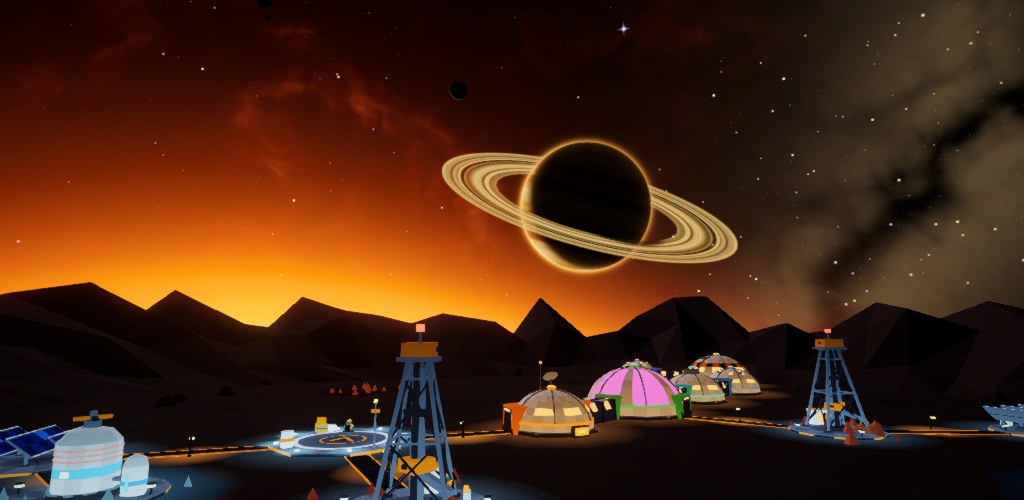
A Corponaut colony at nightfall, seen from the crater floor: domes with their windows lit and, over the rim, a ringed gas giant against the glow of sunset.

Join the beta

The beta is open to anyone who wants to try it. You need an Android phone and the same Google account for all three steps.

  1. Join the group

    It is a Google Group. Sign in with the Google account on your phone and press the join button. Nobody has to approve you.

    Open the group
  2. Become a tester

    With that same account, open this Google Play page and accept becoming a tester. It is a single button.

    Become a tester
  3. Install the game

    It now shows up on Google Play like any other game. If it does not appear at once, wait a few minutes and open the link again.

    Go to Google Play

The group only grants access: Google Play requires the testers of a closed beta to belong to one. Something not working, or want to tell us what you think? Write to mendrugoworks@gmail.com.
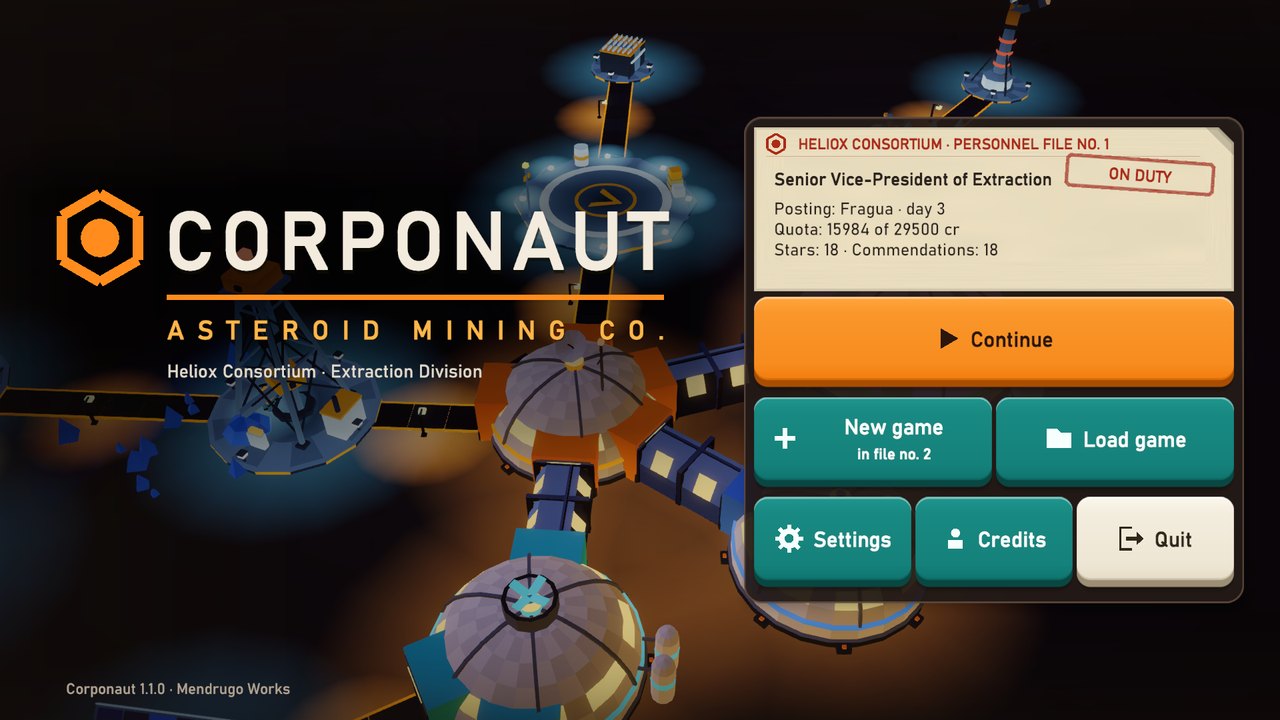
The Corponaut title and the main menu over the player's own base, at night: a Company sheet with their personnel file — rank, posting, quota, stars and commendations — and the Continue, New game, Load game, Settings, Credits and Quit keys.
The main menu

Build a base you can read at a glance

  • Domes and rigs joined by corridors and walkways: the colony is a network, and it looks like one.
  • The Company no longer sells you the base: it sells you leave to build it. Money buys blueprints, the rock gives materials and a technician raises every site.
  • Nothing is placed when you lift your finger. There is always a “Confirm”.
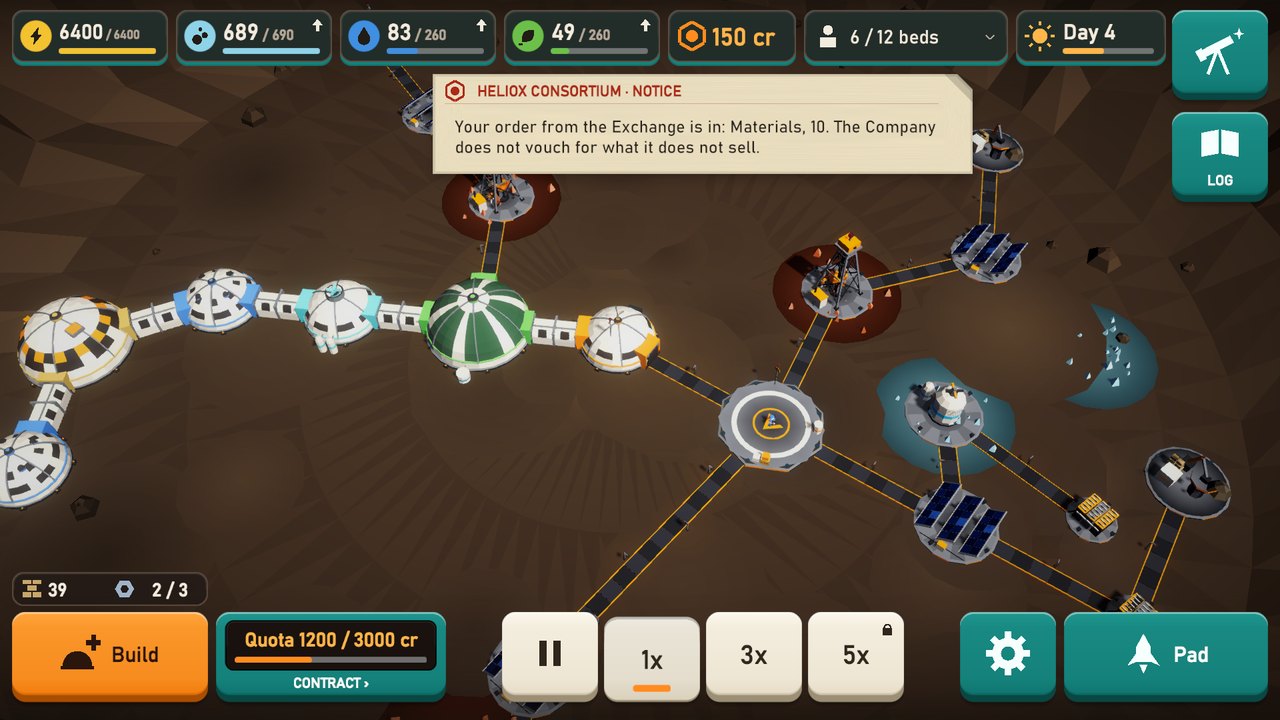
The colony from far off, by day: a row of domes joined by corridors and, joined by walkways, the pad, the solar arrays, the ice extractor, the quarries and a drill on its seam.
The whole colony
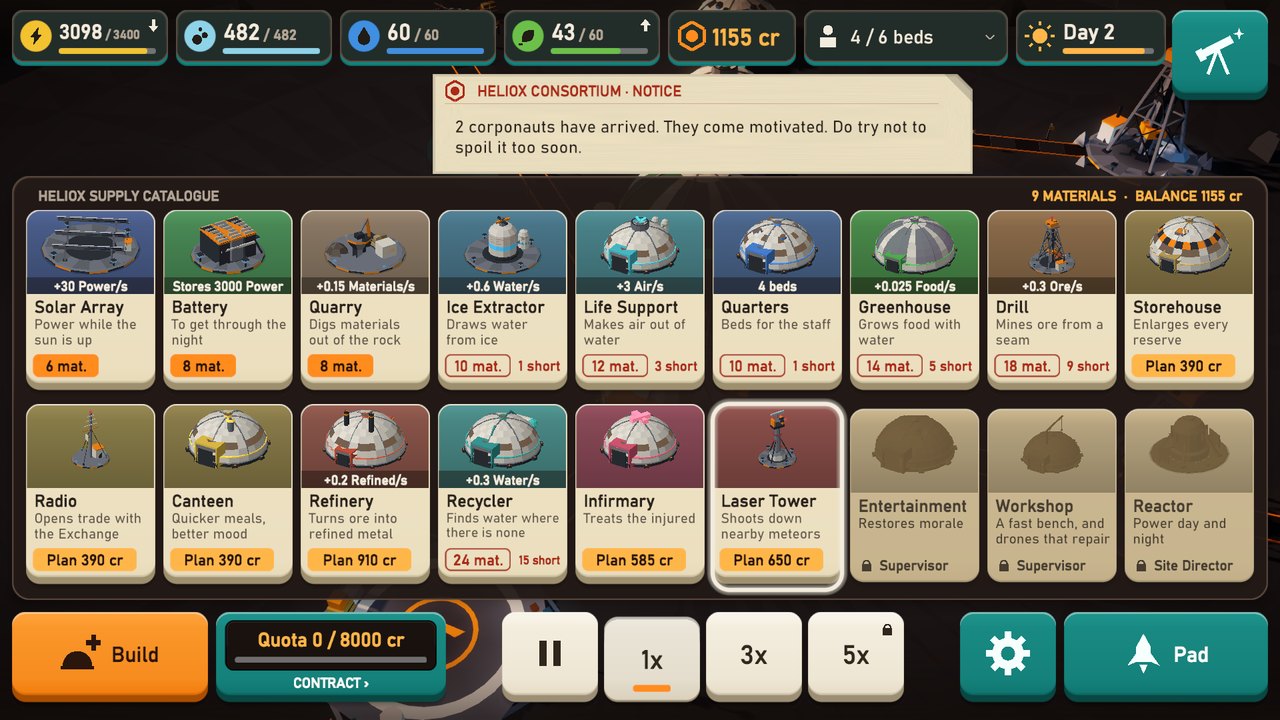
The Heliox supply catalogue: eighteen cards, each with a picture of the structure, what it gives and what it is for. Those that can already be built say what they cost in materials; the others, the price of their blueprint; the last three, locked, which rank opens them. At the top, the materials there are and the balance.
The Heliox supply catalogue

The colony is raised, not bought

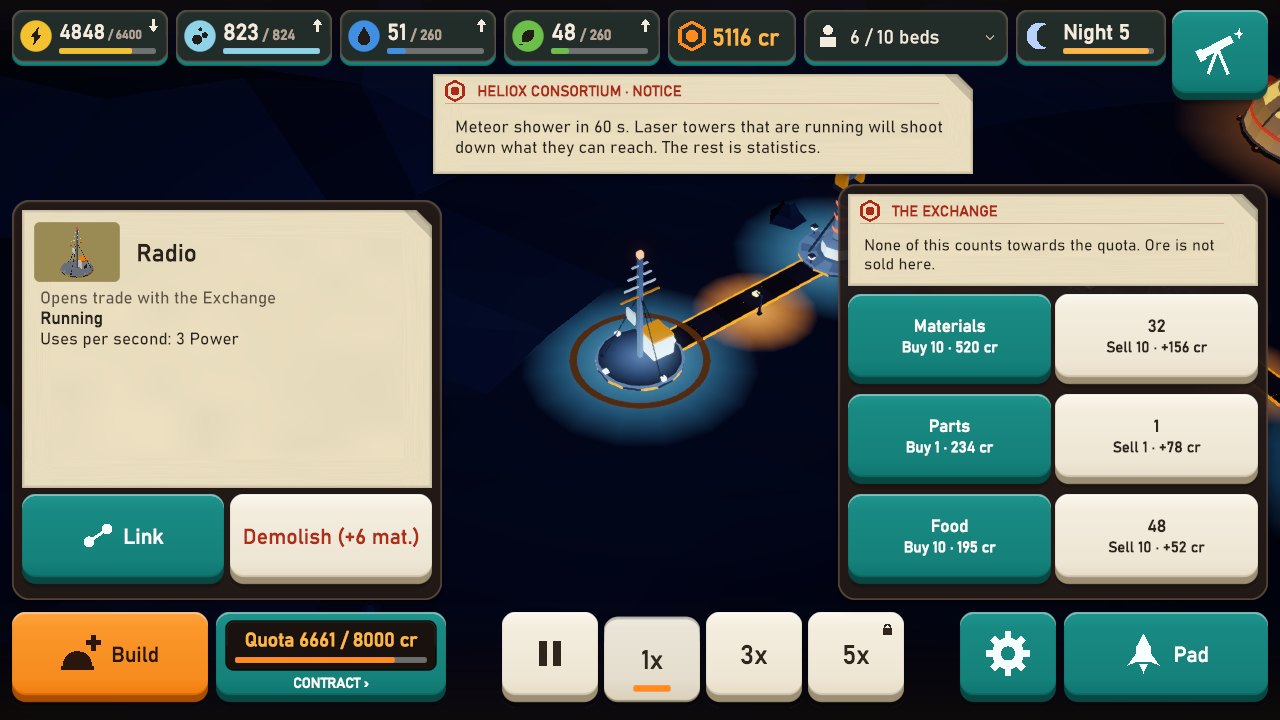
What you place is a site, and a technician raises it: one to a site, and in order. Materials come out of the Quarry; money buys blueprints, once per contract. What breaks is mended with repair parts, which the technician makes at the bench. And with a Radio the Exchange answers: materials, parts and food, at its price. Not ore: ore is the Company's.
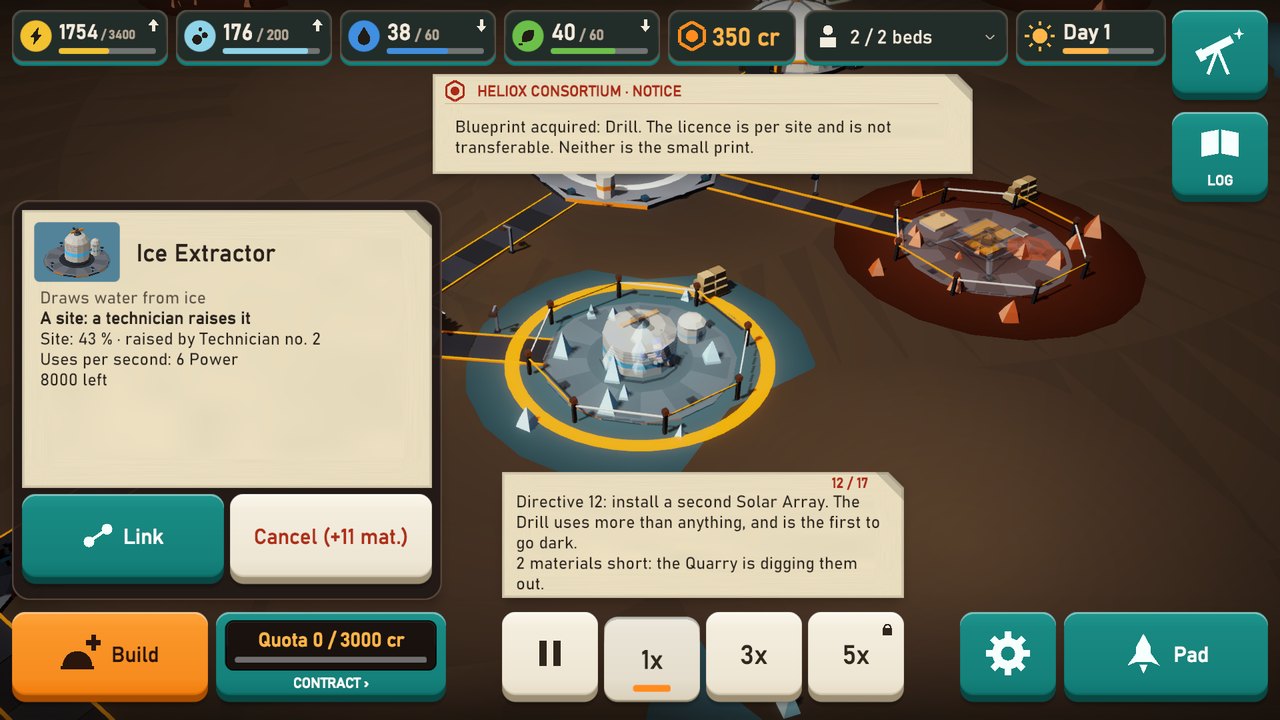
An Ice Extractor half raised, with its stakes and its pallet, and beside it the site of a Drill on its seam. The card reads “Site: 43 % · raised by Technician no. 2”. At the top, a notice from the Company: “Blueprint acquired: Drill. The licence is per site and is not transferable. Neither is the small print.”
A site, and who is raising it
A Radio's card and, on its right, the Exchange's tray, at night: “None of this counts towards the quota. Ore is not sold here”, and three rows — Materials, Parts and Food — with one key to buy and one to sell each lot.
The Radio and the Exchange

Nine resources, and not one more

  • Power
  • Air
  • Water
  • Food
  • Ore
  • Refined metal
  • Materials
  • Parts
  • Credits

By day the panels are in charge; by night, the batteries. Whatever is not vital waits for dawn.
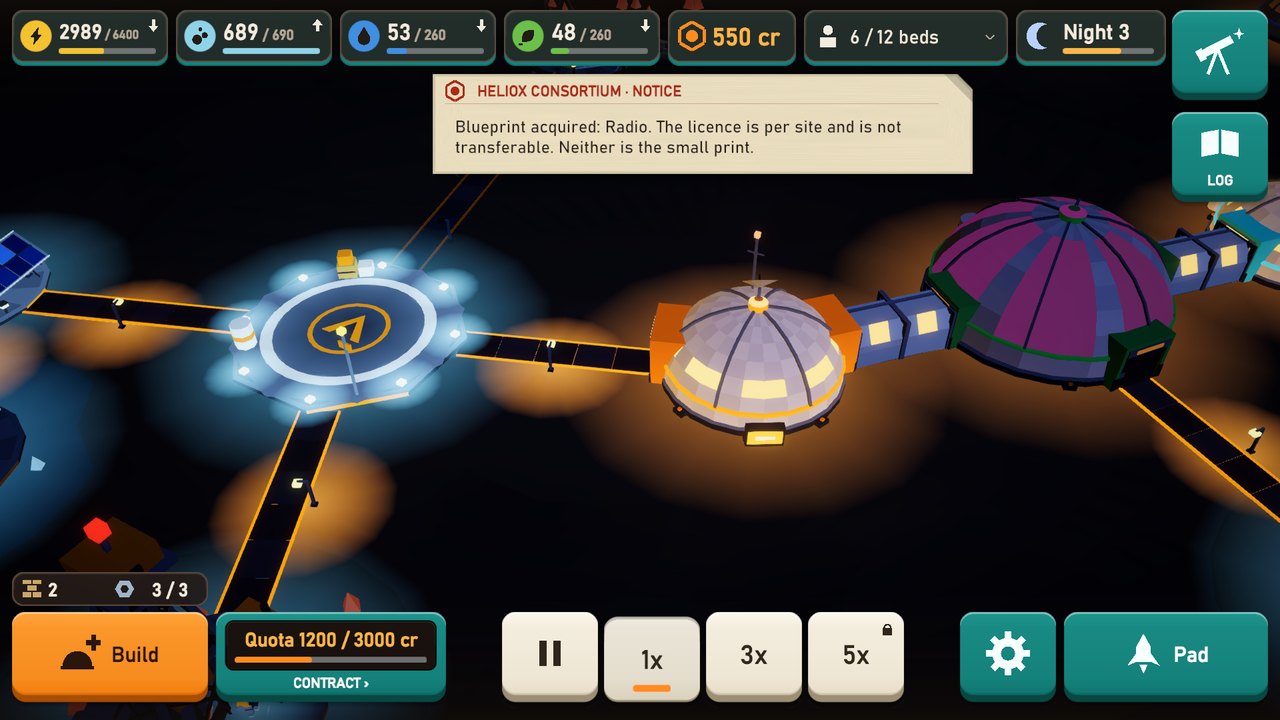
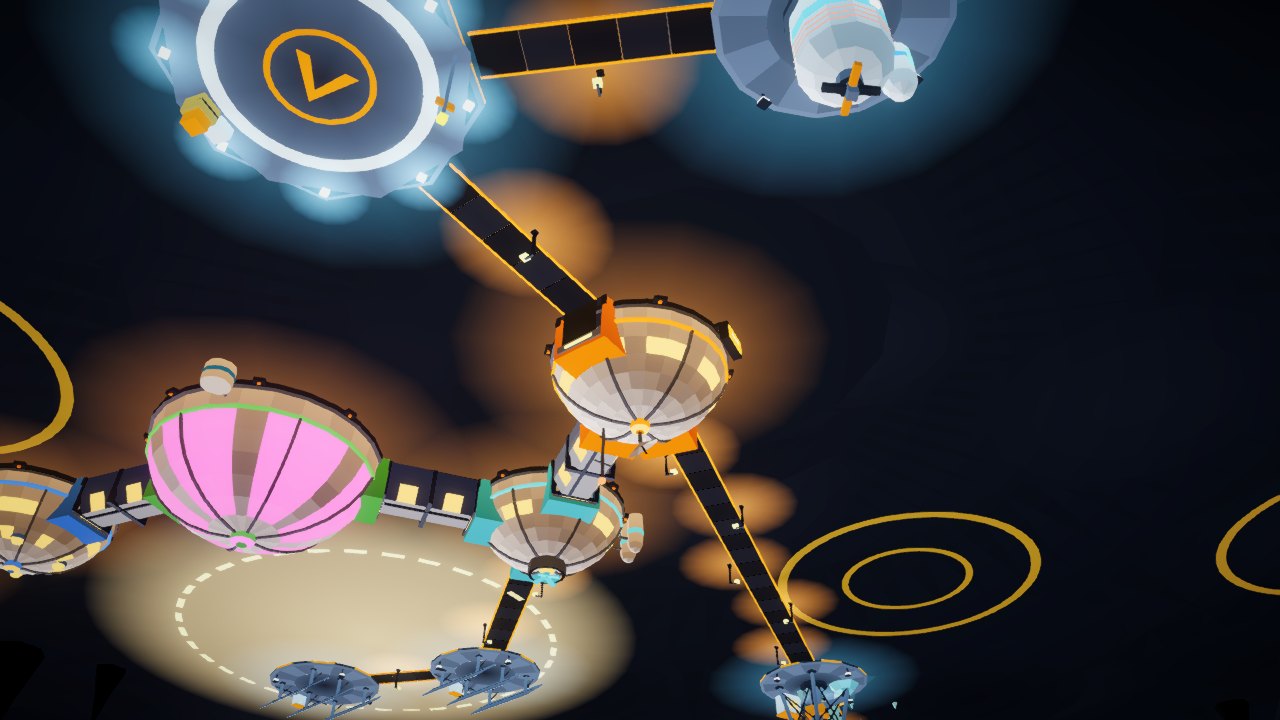
The base at night: the ground almost black and, on it, the pad with its ring of blue beacons, a dome with its windows lit in its pool of warm light and the lit edges of the walkways. A notice from the Company reads: “Blueprint acquired: Radio. The licence is per site and is not transferable. Neither is the small print.”
By night

Domes that open

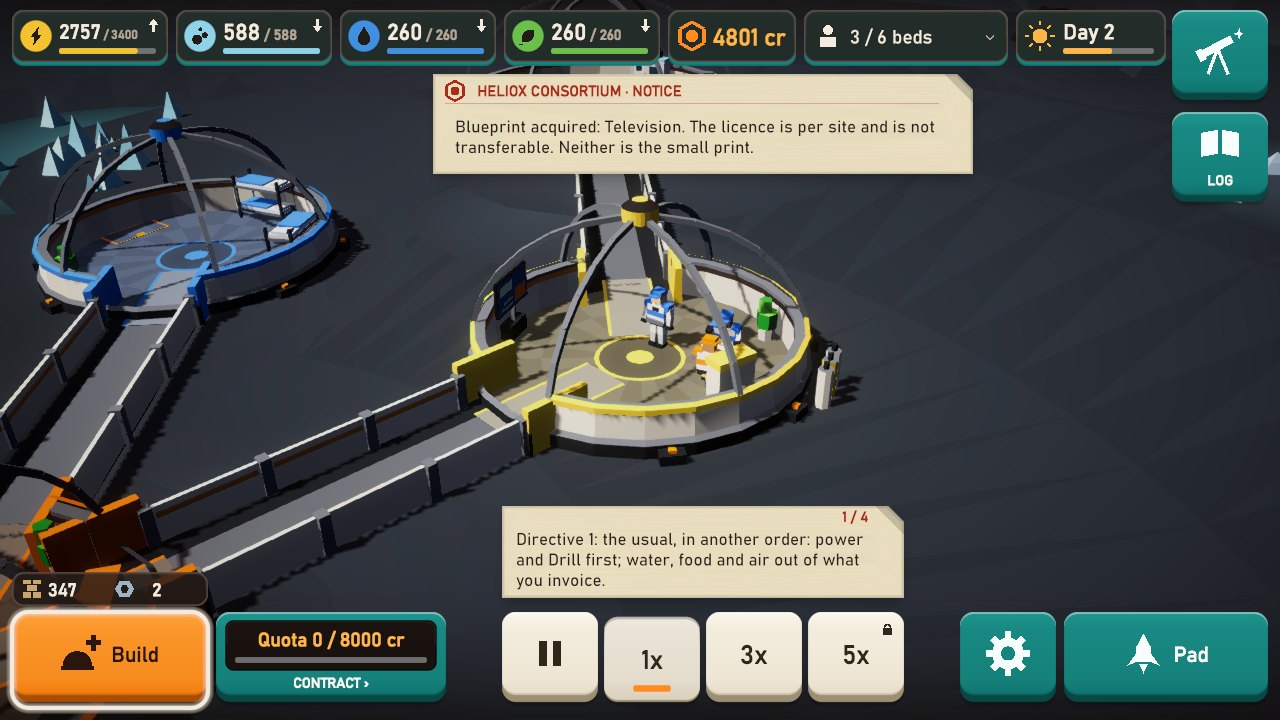
Bring the camera close and the domes open: you see the room, who is in it and what has been built inside. Every dome has holes: another bunk, a television in the canteen, a gym. There are twenty-five modules, and an Entertainment room where variety counts: three televisions amuse nobody more than one.
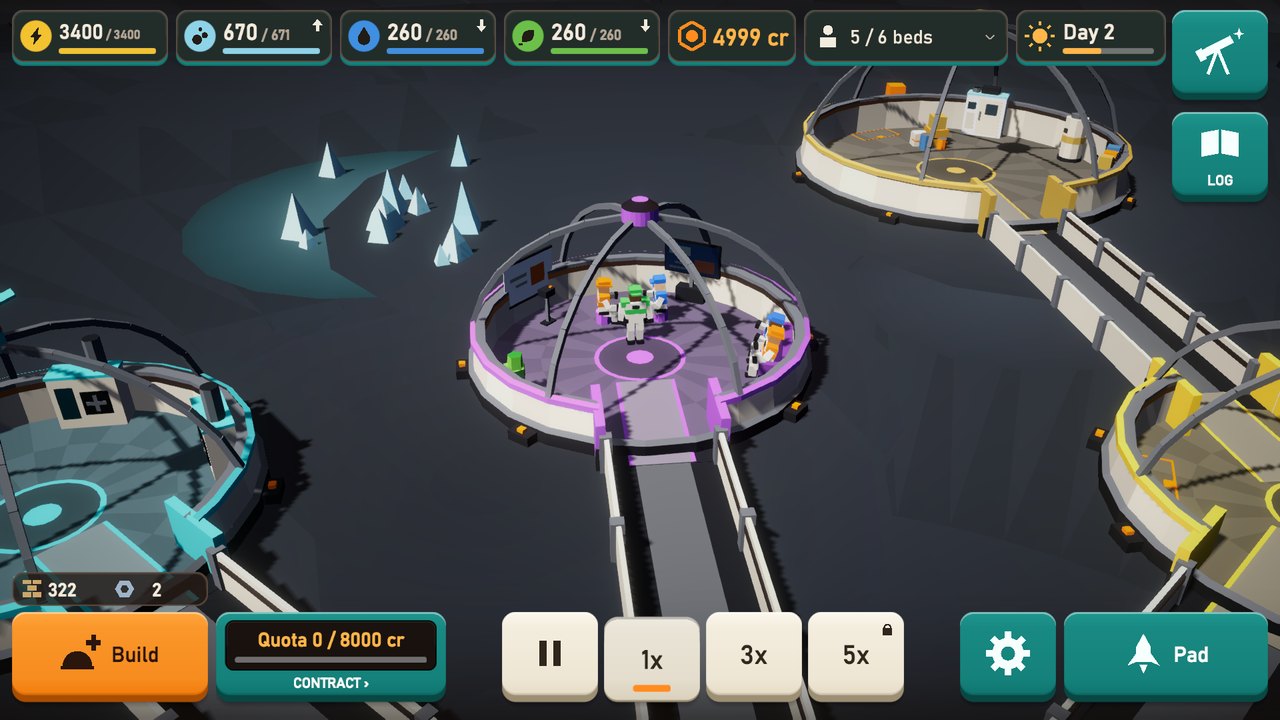
An Entertainment room opened, by day, with five corponauts in it: three round the games table, under the projector's screen and the television, and two sitting by the wall. Round it, more open domes, each with its own things inside.
The Entertainment room, inside
A Canteen opened, seen from close: two corponauts eat at the table, with the dispenser by the wall and the television on. At the top, a notice from the Company: “Blueprint acquired: Television.”
A Canteen with its three holes taken

Know what you have and where it is going

The gauges are keys. Each resource opens its sheet of the almanac: how much there has been, what came in and went out each day, who makes it and who uses it. The beds gauge lets down the staff by trade. The day gauge opens the mission log, with everything that has happened. The Company calls it transparency.
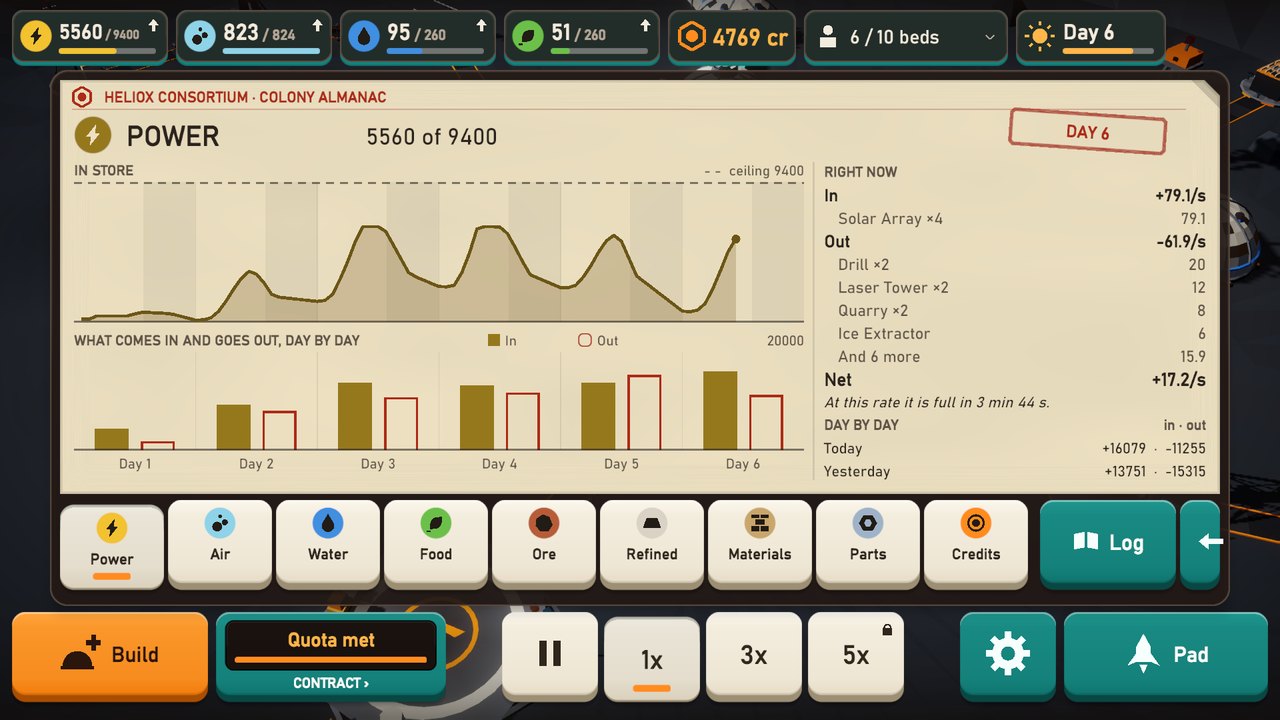
The colony almanac at the power sheet: the curve of how much there has been these last days, two bars a day for what came in and what went out and, on the right, who makes it, who uses it and the net figure: “At this rate it is full in 3 min 44 s”.
The almanac
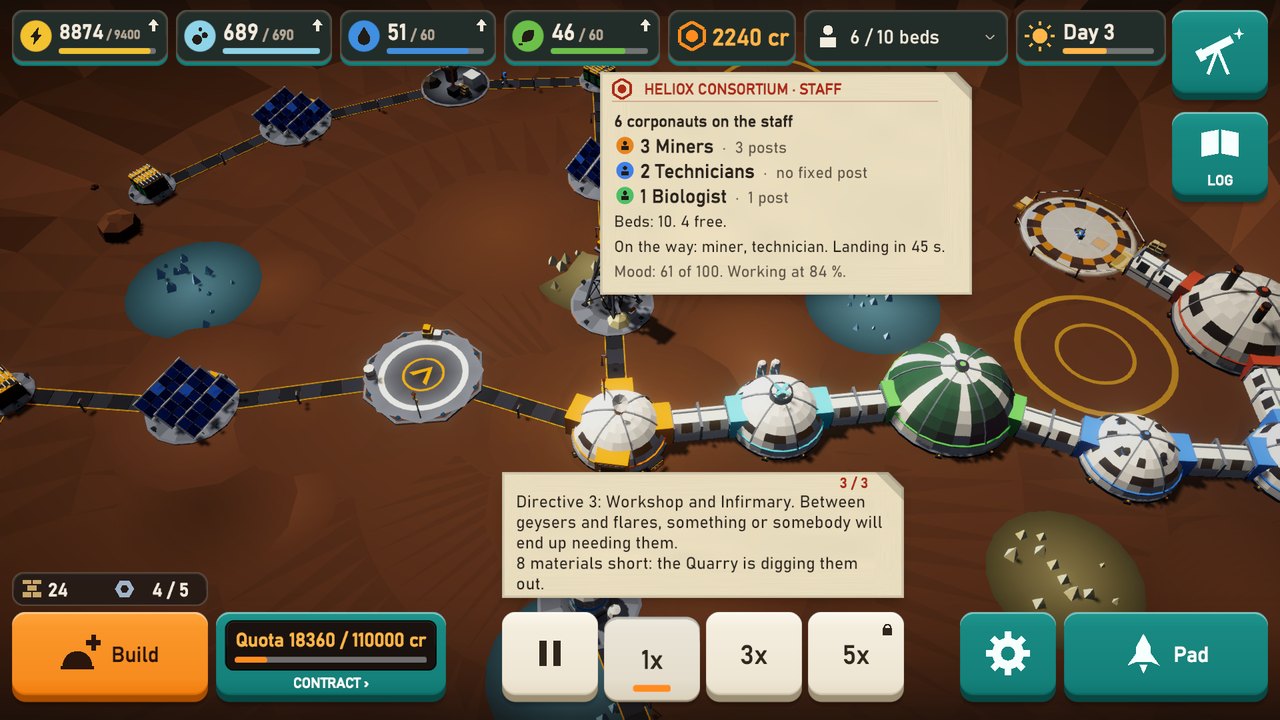
A colony by day with the staff sheet let down under its gauge: six corponauts — three miners, two technicians and a biologist — with their posts, the free beds and who is on the way.
The staff, by trade
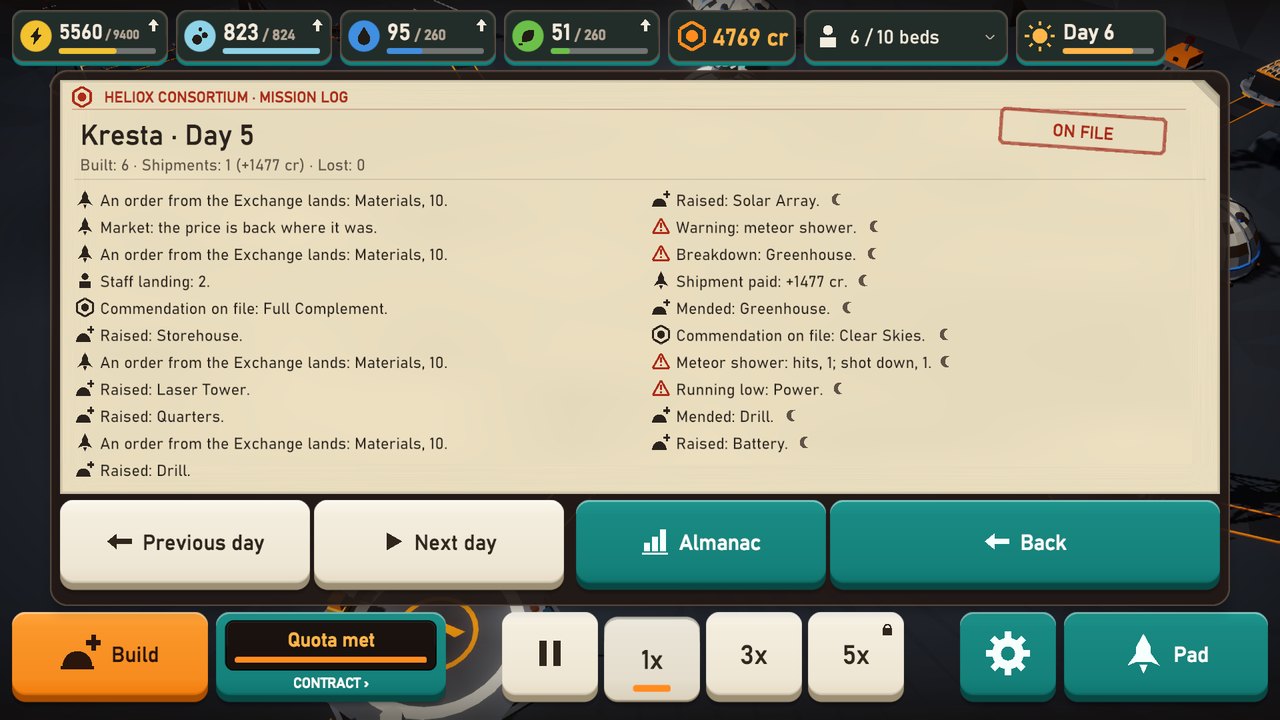
The mission log, day 5 on Kresta: a line for each thing that happened — orders from the Exchange landing, what is raised, a shipment paid, a meteor shower warning and its hits, a breakdown and its repair — with a moon on those that happened at night.
The mission log

Corponauts who look after themselves

Miners, technicians and biologists eat, sleep and fill their posts with nobody directing them. When the sky turns ugly they take cover unprompted. It is one of the few things they do unprompted.
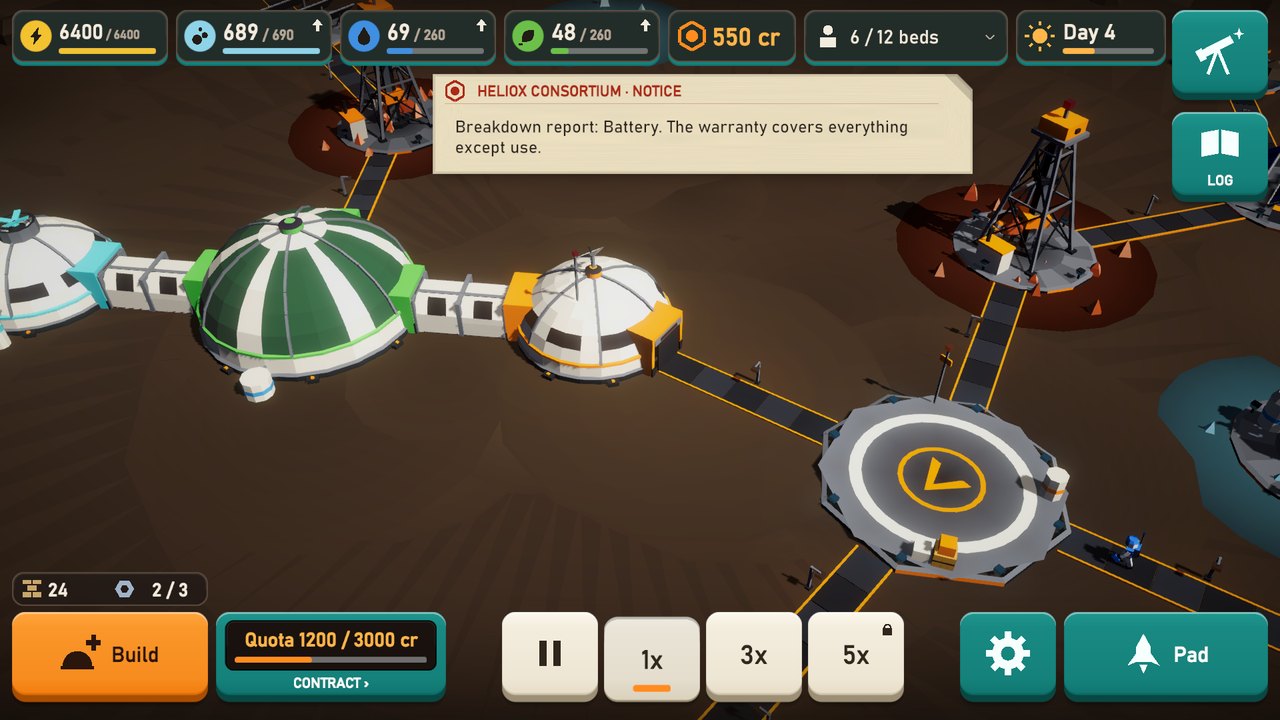
The base by day: the greenhouse and the Command Module joined by a corridor, the pad and a drill on its seam. Along the top, the resource gauges, the lookout and log keys in the corner and a notice from the Company: “Breakdown report: Battery. The warranty covers everything except use.” At the bottom left, the strip of materials and parts.
The base

An asteroid is not a quiet place

Breakdowns, meteor showers, breaches, solar flares, Company inspections, geysers, quakes, staff stoppages and pad closures. All of them warn you first. All of them have an answer. None of them apologises.
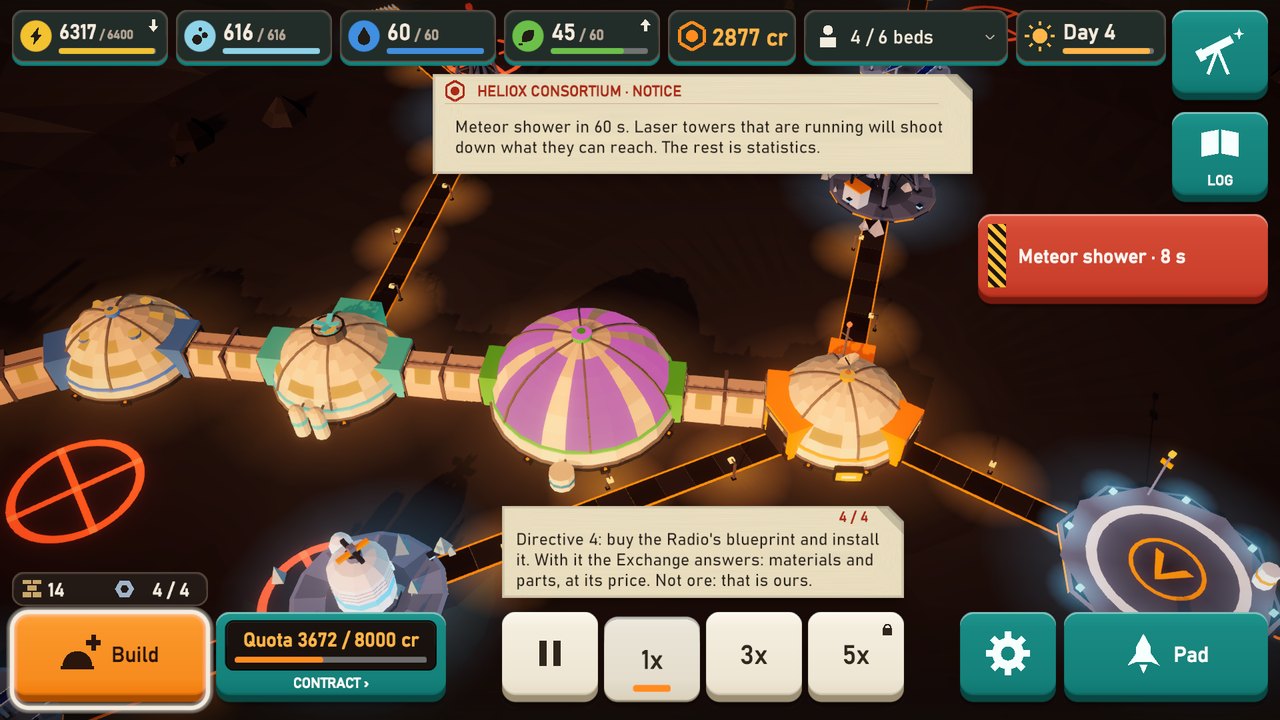
A colony at dusk under a meteor shower warning: marks on the ground where they will land, a red alert counting down and a notice that reads: “Laser towers that are running will shoot down what they can reach. The rest is statistics.”
Meteor shower

Look up

One key takes the camera down to the crater floor and has it look over the rim. Every sector has its own sky: a ringed giant, a sun too close, a broken moon. By night the base is seen by its own light. Looking is free.
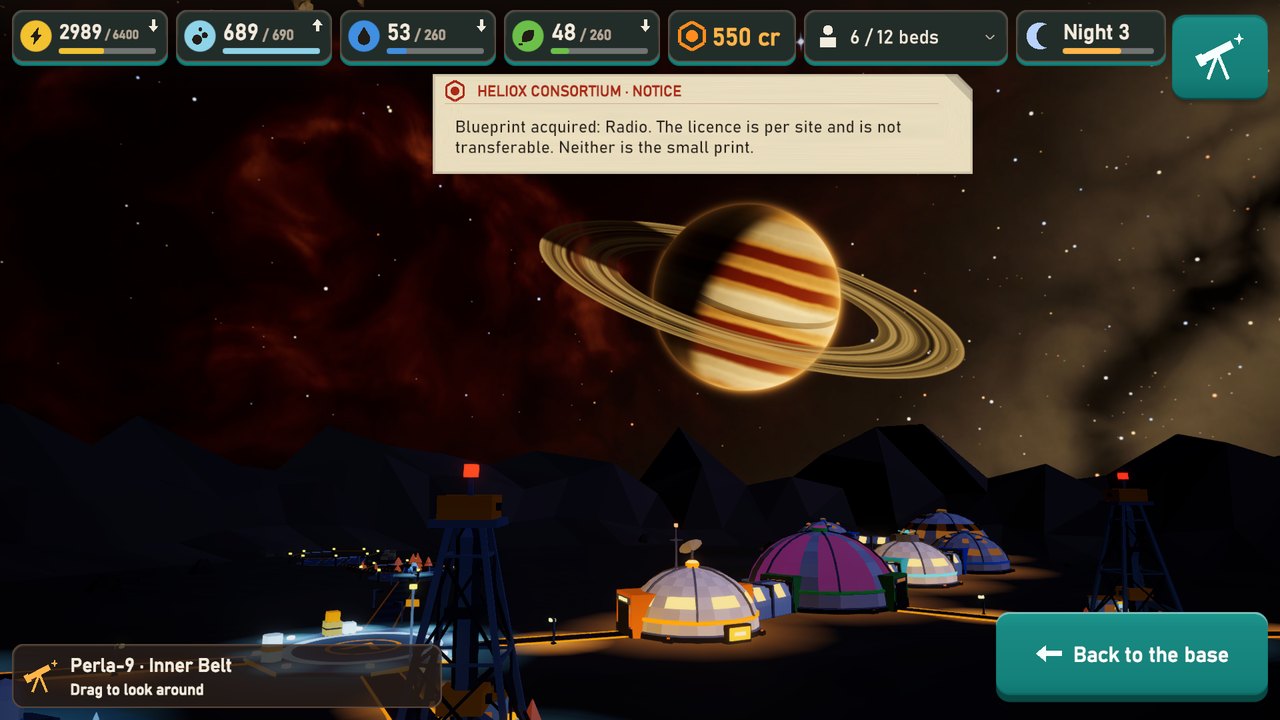
The sky from the lookout, at night: a gas giant with rings and bands over the rim of the crater and, at its foot, the base, lit. Below, the plate “Perla-9 · Inner Belt. Drag to look around” and the “Back to the base” key.
The lookout

Thirty asteroids, one career

Six sectors of five sites, from Perla-9 to Finisterre. Each with its own ore, its own day, its own night and its own way of making your life difficult: one where night never falls, one where no reactor is delivered, one with the base the last person left behind.

Meet the quota, earn stars, and rise from Intern to Shareholder. Your salary is unchanged, for consistency.
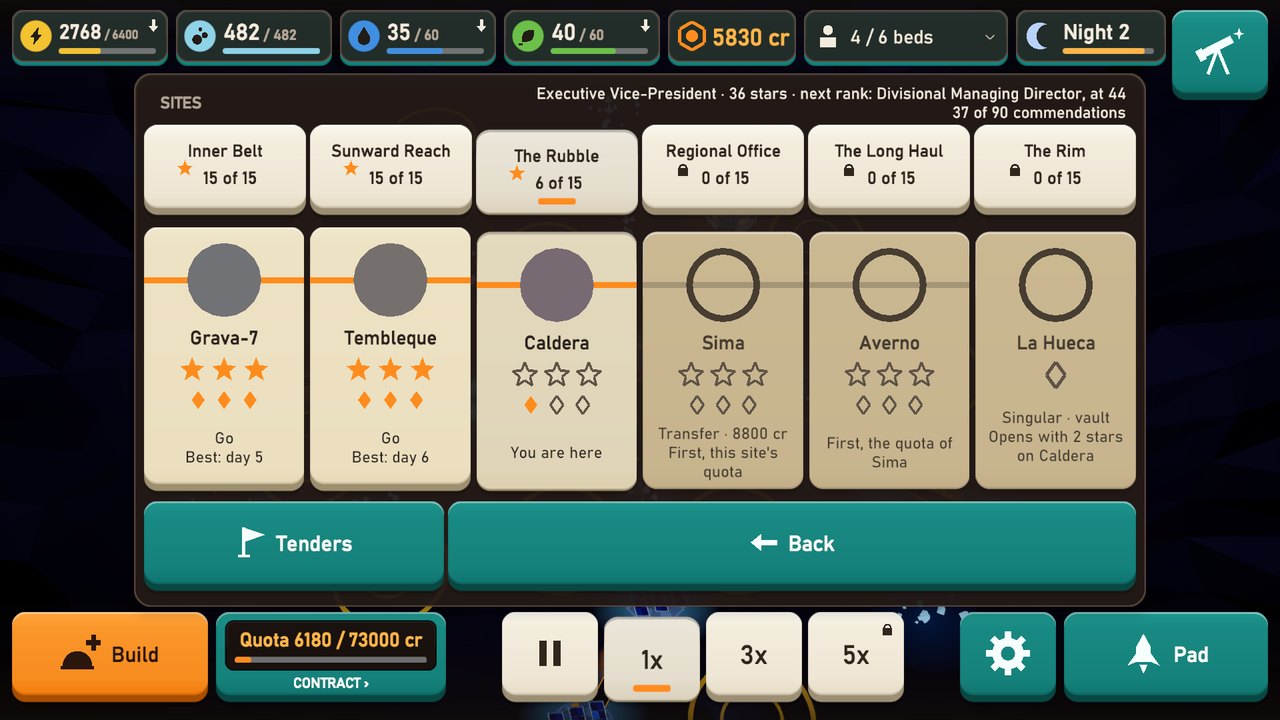
The map of sites: six sector keys — Inner Belt, Sunward Reach, The Rubble, Regional Office, The Long Haul and The Rim — two of them complete and three padlocked; below, the five asteroids of the Rubble, each with its stars and its commendations, and the card of its singular contract. At the bottom, the Tenders key.
The map of sites
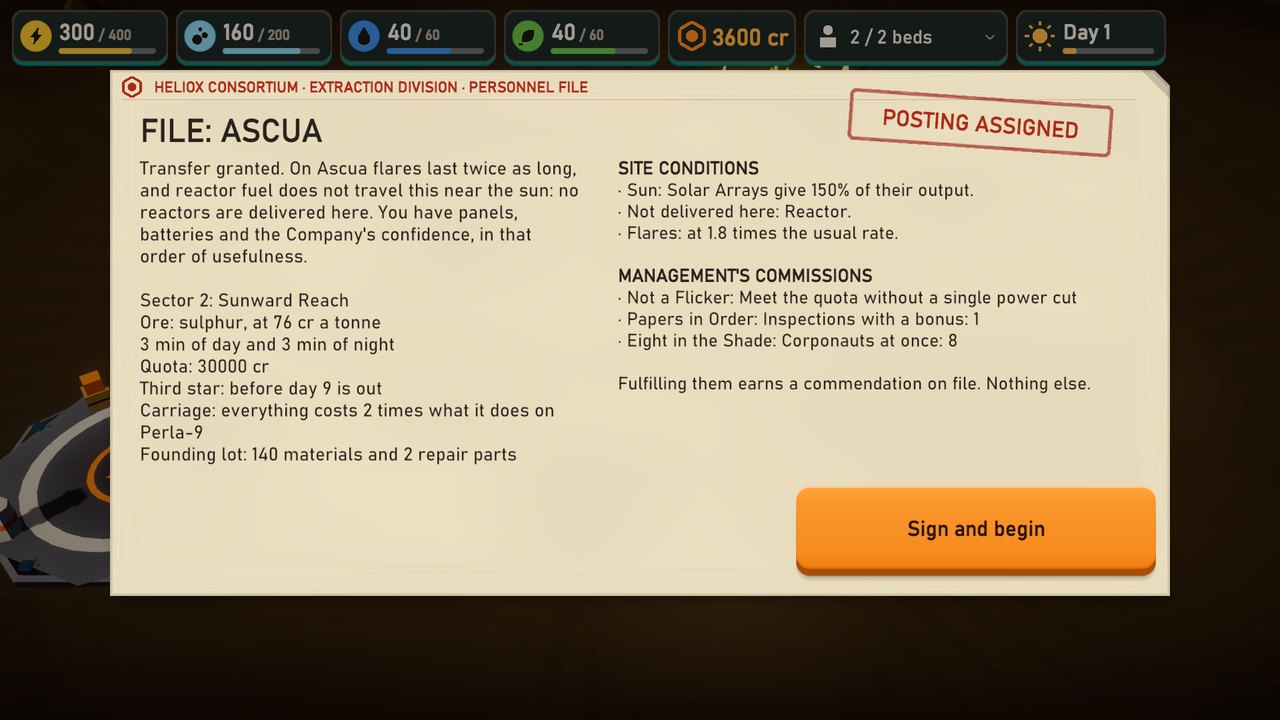
The file for Ascua, in the second sector: the letter of transfer, the site conditions — panels give 150 %, no Reactor is delivered, flares come more often — management's three commissions and the “Sign and begin” key.
The Ascua file
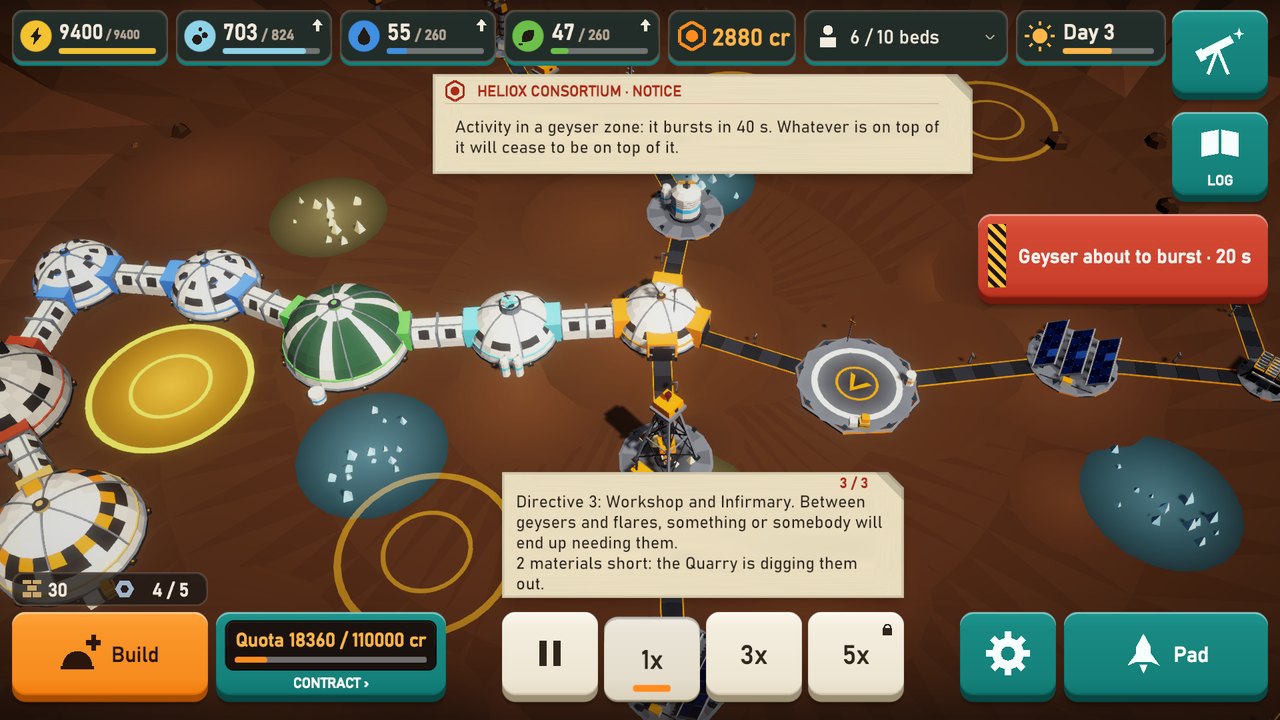
Vulcano, by day: a colony of seven domes on reddish ground, geyser zones marked with circles and a red alert: “Geyser about to burst · 20 s”.
Vulcano

Other kinds of ground

Not every asteroid is a flat basin. There are tablelands split by chasms, where what crosses is a bridge and you cross it in the open; and vaults, where the base hangs from the roof of a cavern and what is let go does not come back. There are six singular contracts, one to a sector. They give a seal on your file and no stars: you come to see the place.
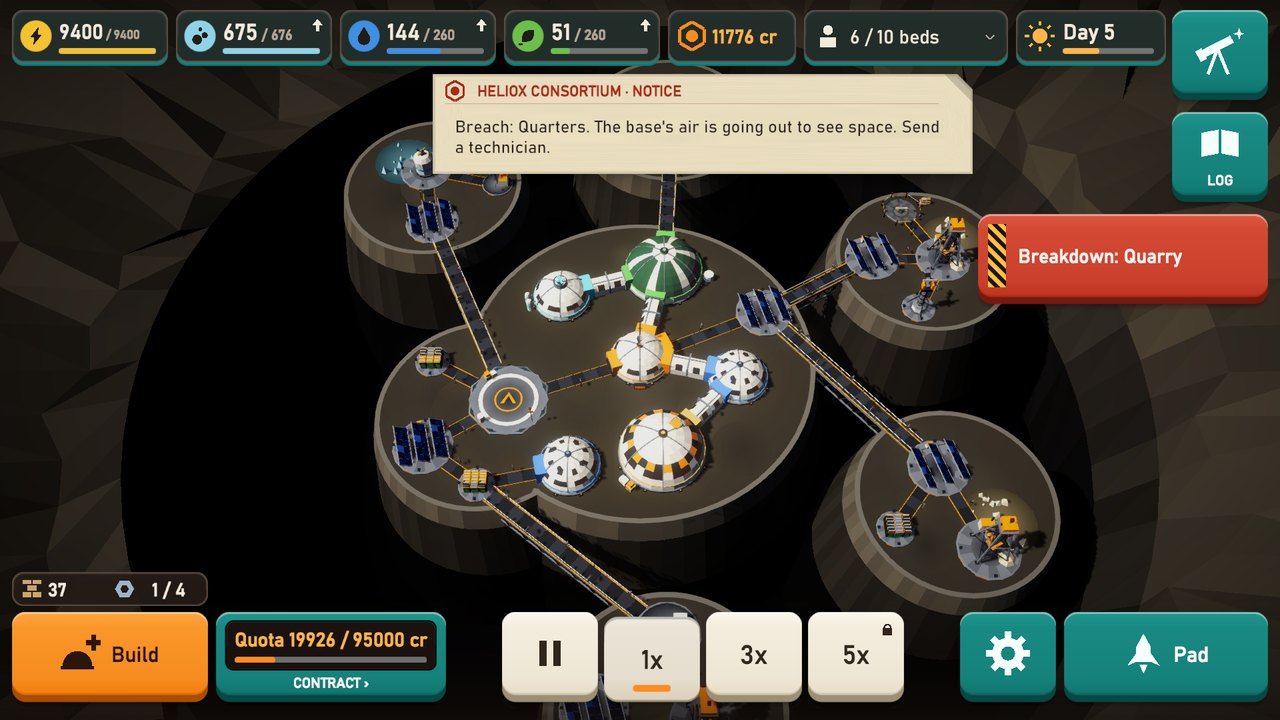
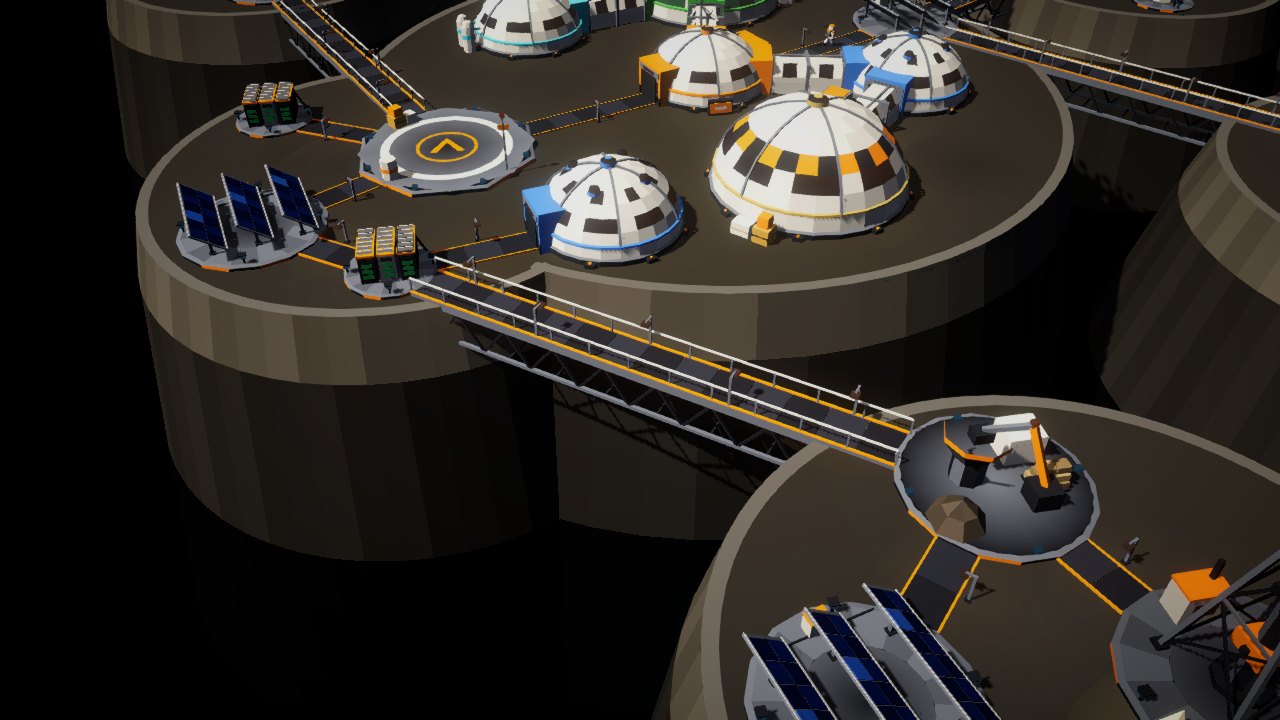
El Desfiladero from far off, by day: one large tableland with the pad and the domes, and others round it with panels, drills and quarries, joined by bridges over black chasms. A notice from the Company warns of a breach.
El Desfiladero: tablelands, chasms and bridges
A trussed bridge crosses a chasm between two tablelands: on one side, the pad and the domes; on the other, a drill. The walls of the tablelands drop into the dark.
A bridge over a chasm
A base hung from the roof of a cavern, seen from close: the pad, the domes upside down and the links, lit in the dark, with the circles where the roof comes down.
La Hueca: the base, hung from the roof

And another company on the same rock

Three tenders against another corporation, which works the same asteroid at the same time and in plain sight. You dispute a seam, buy at the same Exchange, and one of you gets there first. Losing does not rescind the contract: you meet it as second, which is also a number.
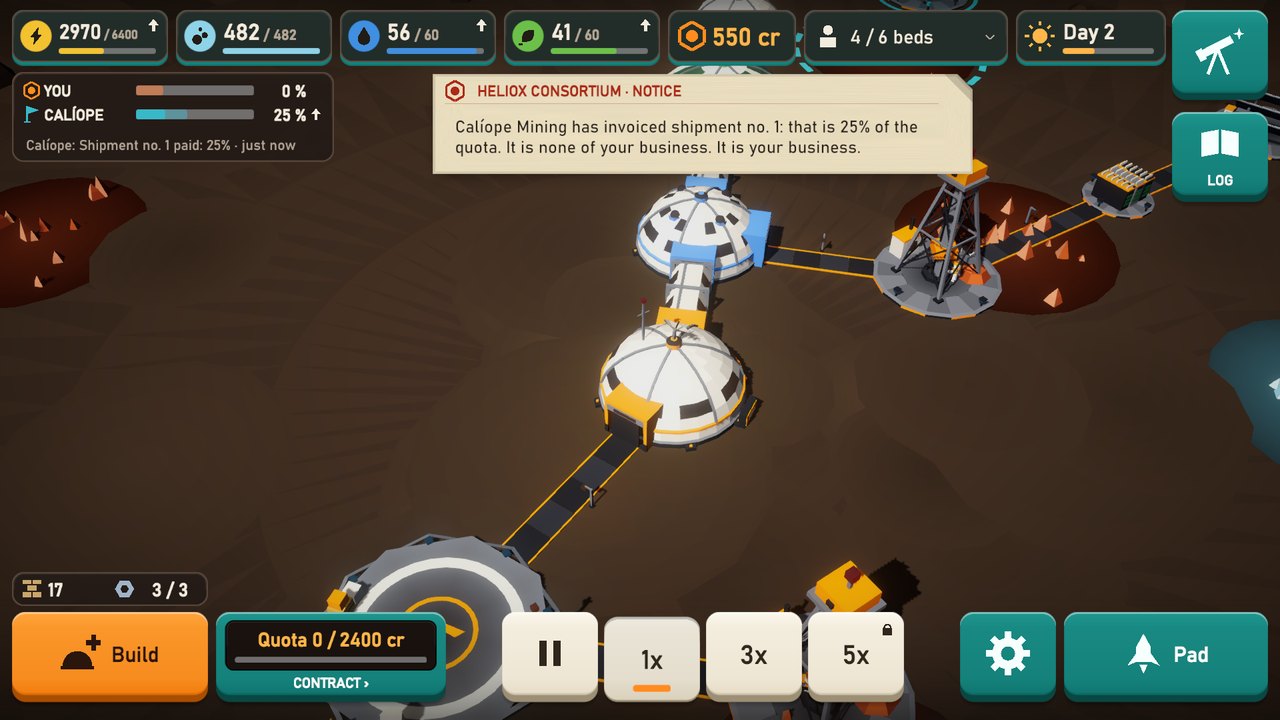
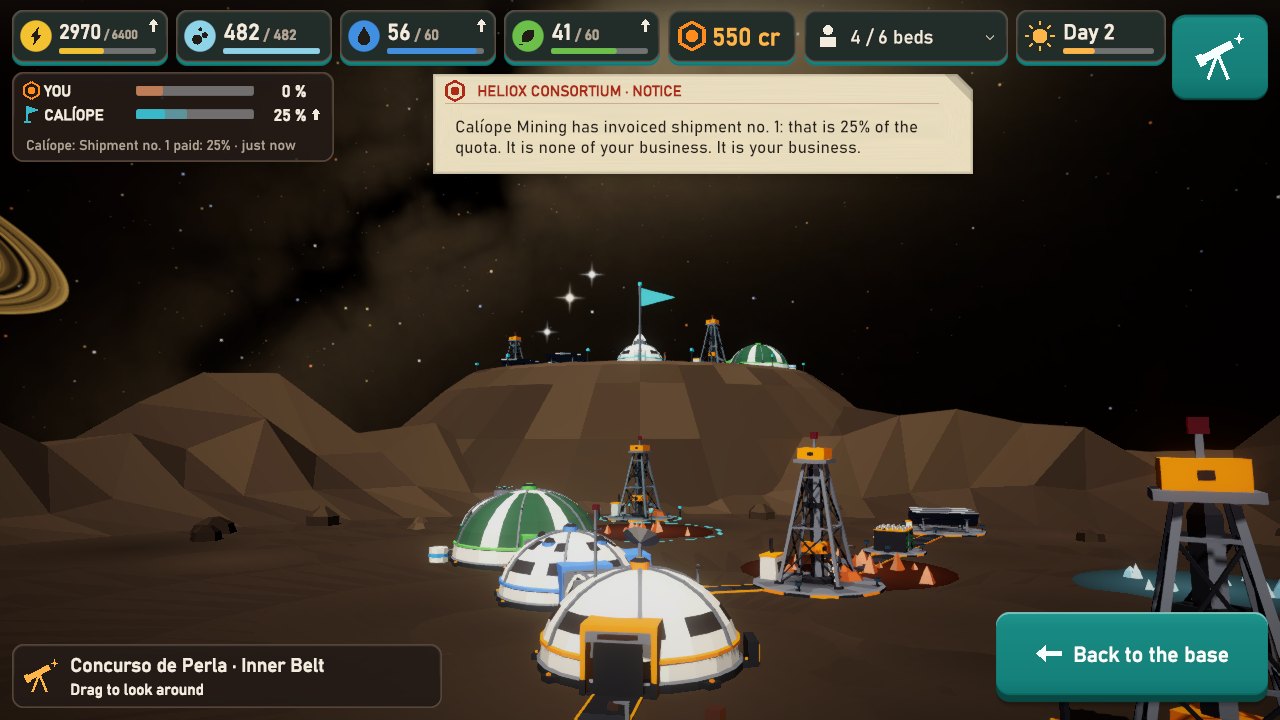
A tender, on the second day: under the gauges, the race plate — “You 0 %”, “Calíope 25 %” — and a notice from the Company: “Minera Calíope has invoiced shipment no. 1: that is 25% of the quota. It is none of your business. It is your business.”
A tender, mid-race
From the lookout, by day: at its foot, your own base; in the distance, on the rim of the basin, the other corporation's concession, with its domes and its pennant. At the top, the race plate.
The other concession, from the lookout

The manual that was lost

Annex 7-C, complete: how to start and how to save, how things are built, the nine resources, parts and the Exchange, the almanac and the log, the twenty structures and the twenty-five modules that go inside them, the corponauts, the lookout and the six skies, the alerts and how to answer each one, the quota, the ranks, the thirty asteroids, the reliefs and the tenders. With the game's own figures.

Read the manual

What it is not

  • It is not a waiting game: there are no timers to skip by paying.
  • It is not pay-to-win: nothing on sale brings the quota any nearer.
  • It needs no account and no connection to play.

Privacy policy

In English and Spanish. Adjustable text size. A light graphics mode for modest phones.

The screenshots are the game running. The two of rooms seen from inside were set for their picture: their modules and their people were put where you see them.

Heliox Consortium · Notice

The Company wishes you a productive stay.